
If you have recently bought an electric vehicle, or you are planning to, one of the first questions that usually comes up is this: Can I charge it properly at home?
For many households, the answer is yes. But the best setup depends on your home’s electrical system, where you park, how often you drive, and whether you already have solar. That is why EV charger installation in Ballarat is becoming a popular service for local homeowners who want safe, simple, and reliable charging at home.
The good news is that installing a home EV charger is usually straightforward when planned properly. The key is understanding the costs, the electrical requirements, and which charger is the right fit for your lifestyle.
This guide walks you through everything so that you can feel confident about your next step.
Why more Ballarat homeowners are installing EV chargers
Electric vehicles are becoming more common across Ballarat and regional Victoria. People like the lower running costs, smoother driving experience, and the convenience of being able to charge at home instead of making regular stops at a petrol station.
Home charging is especially appealing because it makes owning an EV easier. Instead of thinking about fuel, you simply park your car, plug it in, and let it charge while you sleep or while your solar system is producing energy during the day.
For many homeowners, a dedicated charger also feels like a smart long-term upgrade. It adds convenience now and helps future-proof the home as more households move toward electric cars, solar, batteries, and all-electric living.
Can you charge an EV from a normal powerpoint?
Technically, yes. Many EVs can charge from a standard powerpoint using a portable charging cable. This can work in some situations, especially if you drive short distances and have plenty of time to recharge.
But for most homeowners, a standard powerpoint is not the ideal long-term solution. Charging is much slower, and it is usually less practical for daily use. It may be fine as a temporary option, but it is not always the most convenient or efficient way to keep your car ready to go.
That is why many people eventually move to a dedicated home charging unit. A proper charger is faster, more reliable, and designed specifically for regular EV use.
What are your options for home EV charging?
When looking at EV charger installation in Ballarat, there are usually two broad options for homeowners.
The first is basic charging from a standard outlet. As mentioned above, this can suit some people, but it tends to be best for light use or short-term needs.
The second option is a dedicated home EV charger. This is the setup most homeowners prefer once they understand the benefits. A dedicated charger is installed by a licensed electrician and connected to your home’s electrical system with the correct protection and wiring. It allows for faster charging and often includes smart features such as app control, charging schedules, and solar integration.
You may also hear people talk about single-phase and three-phase power. In simple terms, three-phase homes can often support faster charging options than single-phase homes. That said, plenty of homes with single-phase power can still have an excellent EV charging setup. The right solution comes down to your home, your vehicle, and how quickly you want to charge.
EV charger installation requirements in Australia
One of the most important things to understand is that EV charging is not just about mounting a charger on a wall and plugging it in. There are real electrical safety and compliance requirements to consider.
The main EV charger installation requirements in Australia revolve around having the charger installed correctly by a licensed professional, making sure the electrical system can handle the extra load, and ensuring the correct circuit protection is in place.
In practical terms, this usually means your installer will assess:
- your switchboard
- the available electrical capacity in your home
- the distance between the switchboard and charger location
- whether a dedicated circuit is needed
- whether safety switches and protection devices are suitable
- whether the charger location is indoors or outdoors
The installation should be designed to match both your home and your EV. That is why a proper site assessment matters. It helps avoid overloaded circuits, unreliable performance, and future upgrade headaches.
What needs to be checked before installation?
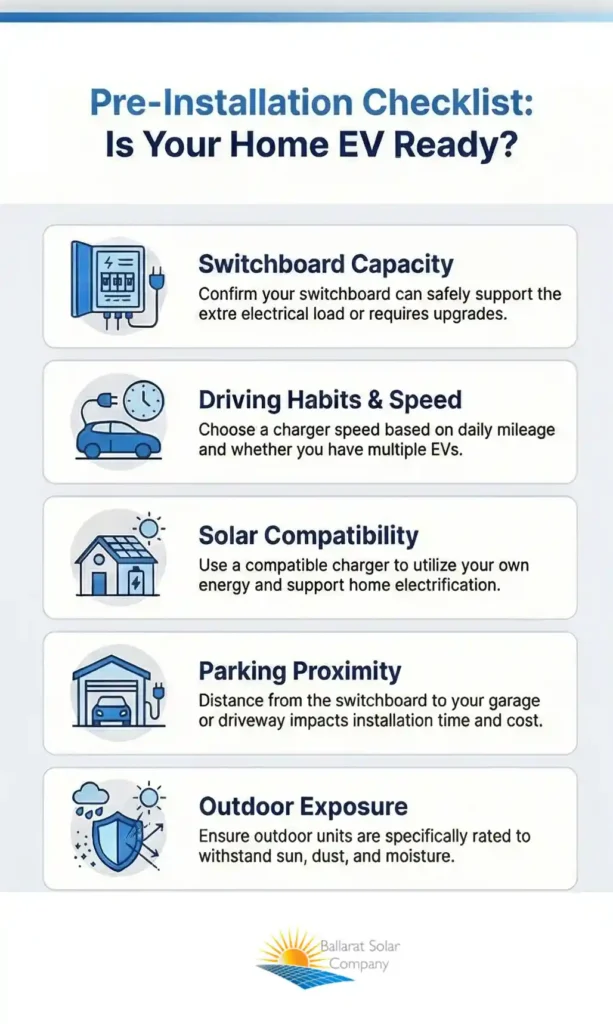
Before any charger is installed, your electrician should look at the home as a whole rather than just the wall where the charger will sit.
1. Your switchboard
Your switchboard is one of the first things that should be checked. The question is simple: can it safely support the extra load of an EV charger?
Some homes already have enough capacity, while others may need minor changes. In older properties, a switchboard upgrade may be recommended before a charger can be installed safely and compliantly.
2. Where you park
The charger location matters more than many people expect. Is the car parked in a garage, under a carport, or on a driveway? Is the wall close to the switchboard, or will the cabling need to travel a long distance?
A charger installed near the switchboard is often simpler and more affordable. If the parking area is further away, the job may take more time and materials, which affects cost.
3. Outdoor exposure
Many chargers can be installed outdoors, but the setup must suit the location. Exposure to weather, sun, dust, and moisture all need to be considered. A good installer will recommend a position that is convenient to use while also protecting the charger.
4. Your driving habits
Not every household needs the fastest charger available. If you only drive moderate distances and can charge overnight, a more modest setup may be perfect. If you drive a lot, have more than one EV, or want to take full advantage of solar, a smarter or faster charger may make more sense.
5. Solar compatibility
If you already have solar, this is a big one. A charger that works well with solar can help you use more of your own energy instead of importing as much from the grid. For solar households, EV charging can become part of a broader home electrification plan.
How much does EV charger installation in Ballarat cost?
This is usually the first question people ask, and understandably so. The honest answer is that the cost can vary quite a bit from one home to another.
That is because EV charger installation involves two parts: the charger itself and the installation work.
The charger unit can vary in price depending on the brand, charging speed, smart features, and solar compatibility. Then there is the installation cost, which depends on the complexity of the job.
A straightforward installation is generally more affordable when:
- the charger is mounted close to the switchboard
- The switchboard already has enough capacity
- there are no major cabling challenges
- no upgrade work is required
The cost can increase when:
- the charger is a long way from the switchboard
- cabling runs are difficult
- trenching or extra conduit is needed
- the switchboard needs upgrading
- load management or smart controls are added
- a three-phase upgrade is required
So if you are comparing quotes, remember that two homes in the same suburb can have very different installation costs. That is normal. A proper quote should reflect the real conditions of your property, not just a generic price.
What affects the setup you need?
A good EV charging setup is not only about charging speed. It is about making sure the charger works well with your home and your daily routine.
For example, a family with one EV and a garage may need something very different from a household with two electric cars, solar panels, a battery, and limited switchboard capacity.
The setup you need may be influenced by:
- how often you drive
- how quickly you need to recharge
- whether you charge mostly overnight or during the day
- whether you want to use solar power for charging
- whether you want app control or scheduled charging
- whether you plan to buy another EV in the future
The best installations are designed with both current needs and future needs in mind.
Best EV charger for home in Australia: what should you look for?
When choosing the best EV charger for home in Australia, the right answer is not always the most expensive model or the one with the longest feature list. The best charger is the one that suits your home, vehicle, and lifestyle.
Here are the main things worth considering.
Charging speed
You want a charger that gives you practical charging times for your daily needs. Faster is not always necessary, but the charger should be matched properly to your vehicle and household usage.
Smart features
Many homeowners like chargers with app controls, scheduling, usage tracking, and remote access. These features can make charging easier and help you manage electricity use more efficiently.
Solar integration
If you have solar or plan to install it, solar-friendly features can make a real difference. Some chargers are better than others when it comes to using excess solar generation.
Load management
This is especially useful in homes where electrical demand is already high. A charger with dynamic load management can help prevent overloading by adjusting charging based on what the home is using at the time.
Tethered or untethered design
A tethered charger has a charging cable attached. An untethered charger lets you plug in your own cable each time. This often comes down to personal preference, convenience, and appearance.
Warranty and support
It is always worth choosing a product with solid support and a good warranty. A charger is a long-term home upgrade, so quality matters.
Why solar and EV charging are such a good match
As solar installers in Ballarat, this is where things get especially exciting.
If you have rooftop solar, an EV can become another smart way to use the energy your system generates. Instead of exporting all that daytime solar back to the grid, you may be able to use some of it to charge your vehicle.
That can help lower your running costs and improve the value you get from your solar system.
For some households, daytime charging works well if the car is at home during solar production hours. For others, smart chargers can help manage charging more effectively around available solar or off-peak electricity.
This is why EV chargers are increasingly part of a bigger electrification conversation. Solar, batteries, hot water heat pumps, induction cooking, and EV charging all work together to create a more efficient home.
Common mistakes to avoid
Homeowners often make the best decisions when they slow down and look at the whole picture rather than choosing based on price alone.
One common mistake is buying a charger first and only then asking whether the home can support it properly. Another is assuming every installation is the same. In reality, the right charger and the right installation plan should come first, and the brand choice should follow.
It is also easy to underestimate the value of future planning. Even if you only have one EV now, it can be worth considering whether you may add another electric vehicle later, or whether you want the charger to work with solar down the track.
And of course, the biggest mistake is using someone who is not properly qualified for the job. EV charging involves real electrical demand, so safe and compliant installation matters.
Why professional installation matters
A professionally installed EV charger gives you more than just convenience. It gives you peace of mind.
You want charging that is safe, reliable, and suited to your home. You want to know the circuit protection is correct, the charger is mounted in the right place, and the setup will perform properly day after day.
A professional installer can also help you avoid overspending. Sometimes the best answer is not the biggest charger, but the smartest setup. Good advice can save money upfront and make the system more useful over time.
For homeowners in Ballarat, there is also extra value in working with a team that understands both EV charging and solar. That way, your charger is not treated as a stand-alone product. It becomes part of a smarter energy plan for the home.
Final thoughts
Installing an EV charger at home can make electric vehicle ownership much easier. It is convenient, practical, and often much more efficient than relying on a standard powerpoint alone.
The right setup depends on your switchboard, your parking location, your vehicle, and how you want to charge. It may also depend on whether you already have solar or plan to electrify more of your home in the future.
That is why EV charger installation in Ballarat should always start with a proper assessment. Once you know what your home can support, it becomes much easier to choose the right charger, understand the likely cost, and plan a setup that works for years to come.
If you are comparing models and wondering about the best EV charger for home in Australia, the smartest move is to look beyond the charger itself and focus on the whole system. A well-matched installation will always deliver a better experience than a one-size-fits-all approach.
Ready to install an EV charger in Ballarat?
If you are thinking about home EV charging, we can help you choose the right setup for your home, vehicle, and budget. Our team can assess your switchboard, charger location, and solar compatibility, then recommend a solution that is safe, practical, and built for the way you live.
Get in touch today with Ballarat Solar Company, to book an on-site assessment for your EV charger installation in Ballarat.