If you’re in Ballarat and you’ve already got solar or you’re planning to add it, a battery is usually the next question. People want to know one thing first: Is there a Victorian solar battery rebate in 2026 that makes batteries more affordable?
In 2026, the main “rebate-style” support most Victorians are referring to is the Australian Government’s Cheaper Home Batteries Program, which provides around a 30% discount on eligible small-scale batteries through the Small-scale Renewable Energy Scheme, usually applied via your retailer or installer.
So yes, there’s meaningful help available via solar battery rebate in Victoria, but the key is understanding what’s actually on offer, who qualifies, and how to make sure you don’t miss out due to paperwork or product rules.
Below is a simple, Ballarat-friendly guide to the battery rebate 2026 in Victoria:
What is the Victorian solar battery rebate in 2026, really?
In everyday language, “rebate” can mean a lot of things. In 2026, the big one is the federal Cheaper Home Batteries Program. It supports households and small businesses with a discount on the cost of installing eligible batteries connected to new or existing rooftop solar.
A couple of quick clarifiers that save confusion:
- This program started on 1 July 2025 and continues through 2026, with rule changes taking effect on 1 May 2026.
- The discount is delivered through the Small-scale Renewable Energy Scheme using small-scale technology certificates, STCs.
- Most people don’t “apply” directly to a government portal for this. In practice, your installer or retailer typically handles the STCs, and you see the discount on your quote or invoice.
That’s why you’ll often see it described online as a “rebate”, even though it’s usually a built-in discount rather than a cash payment later.
How much is the solar battery rebate in Victoria in 2026?
The official language is that the program funds around a 30% discount on eligible small-scale batteries connected to rooftop solar.
What you’ll actually see on quotes can vary because the discount is tied to STCs, and STCs change over time. Two practical points matter most:
The install date matters.
The discount you’re entitled to is determined by the STC factor on the date the battery is installed.
The rules change from 1 May 2026.
From 1 May 2026, STC factors decline more frequently, every six months, and the amount of support also changes depending on battery size.
So if you’re comparing quotes in Ballarat, don’t just ask “How big is the rebate?” Ask, “Is this quote showing the STC discount correctly for the install date we’re planning?”
Who is eligible for the battery rebate 2026 in Victoria (homes and businesses)?
Good news for Ballarat: the program supports residential and non-residential premises, meaning it’s relevant for homeowners and many small businesses too.
Eligibility sits around a few core ideas:
- It’s for batteries installed for permanent use, not something meant to be moved and resold.
- The installation must meet program rules, including product and installer requirements.
If you’re a business, the conversation is often about daytime load, peak charges, and protecting operations from evening peak pricing. If you’re a household, it’s usually about storing solar for night-time use and cutting grid imports.
Do I need existing solar panels to claim the Victorian solar battery rebate?
The program is designed to support batteries connected to new or existing rooftop solar.
For Ballarat customers, that means two common scenarios:
- You already have solar: you add a battery that’s compatible with your current system and usage.
- You’re installing solar and a battery together: one job, one commissioning process, often cleaner design outcomes.
The key idea is that the battery discount is tied to the solar ecosystem rather than being a standalone “buy any battery for any purpose” deal.
What battery sizes qualify in 2026?
Battery sizing is where people can accidentally fall out of eligibility, so it’s worth being crystal clear.
An eligible battery system must be 5 kWh to 100 kWh nominal capacity.
STCs are available for the first 50 kWh of new or added usable capacity.
A few helpful notes that matter in real-world installs:
- Smaller batteries can be stacked to meet the minimum size threshold, as long as the final configuration is on the approved list on the date of certification and the whole system is certified properly.
- Adding capacity later can be eligible only in certain circumstances, but there’s an important “think ahead” warning: CER notes you can’t claim STCs for future additional batteries at the same premises if you later decide to upgrade.
In simple terms, try to size it right the first time, especially if you expect your usage to change, like adding EV charging or switching appliances from gas to electric.
What equipment and installer rules do I need to meet?
This is the part that separates a smooth rebate experience from a messy one.
According to the program eligibility information, eligible batteries include:
- batteries approved by the Clean Energy Council, and
- batteries installed by accredited Solar Accreditation Australia installers.
There are also details around battery systems being a single unit or modular cells serving as one system, and rules about stacking and recertifying configurations.
If you’re in Ballarat, this is where a reputable local installer makes life easier: they’ll match the battery to your inverter, confirm approved products, and make sure your documentation and certification are clean.
How do I apply for the solar battery rebate in Victoria?
Most people don’t lodge a separate “rebate application”. Instead, the discount is generally provided via solar and battery retailers and installers.
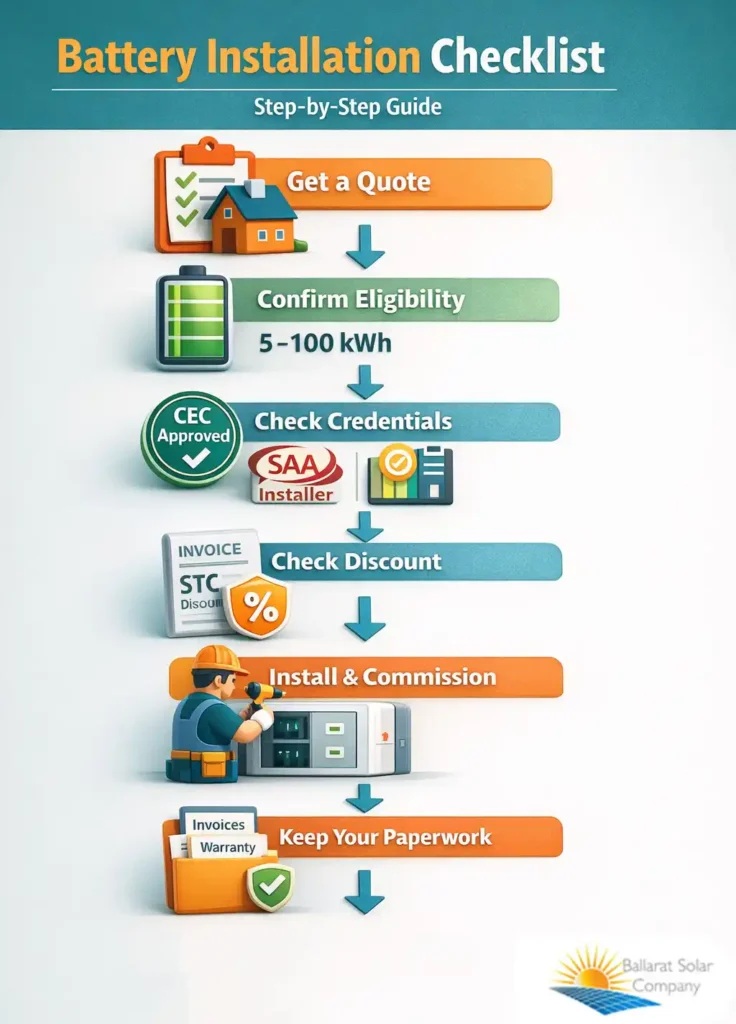
Here’s the simplest step-by-step that works for households and many small businesses:
- Get a site-specific quote
Make sure it includes battery size, usable capacity, and the proposed installation date. - Confirm eligibility basics
Battery size is within 5–100 kWh nominal, and you’re within the support limits. - Check product and installer credentials
The battery is CEC-approved and installed by an accredited SAA installer. - Check how the discount is shown
Your quote or invoice should reflect the STC discount approach used by the retailer. - Install and commission
The install date matters because the STC factor in effect on that date influences the discount. - Keep your paperwork
Hold onto invoices, warranty documents, serial numbers, and compliance records in case you ever need to prove what was installed and when.
If you ever want to manage certificates yourself, the government notes the discount is provided through the creation and trading of STCs, but for most people, the “installer handles it” route is far simpler.
What documents do I need, and what catches people out?
The most common “caught out” moments in Ballarat installs aren’t about eligibility, they’re about assumptions.
Catch 1: assuming the discount is automatic without checking the quote
Always ask your installer to show how the STC discount is being applied, especially if you’re comparing quotes.
Catch 2: planning to add more battery later and claim again
CER cautions that you can’t claim STCs for future additional batteries at the same premises if you upgrade later, so it pays to plan for future load.
Catch 3: mixing up a solar PV rebate with a battery discount
Victorian solar panel rebates are for PV, not batteries. Solar Victoria states the PV rebate cannot be paid towards a battery.
A good installer will walk you through this and make sure your invoice itemises things correctly when PV and battery components appear together.
Can I combine the battery rebate 2026 in Victoria with other Victorian incentives?
Two big points matter for Victorian households:
Solar Victoria battery loans are no longer available for new applications.
Solar Victoria states it is no longer taking applications for interest-free loans for the installation of a battery system.
Solar PV rebates and battery discounts are not the same thing.
If you’re also using Solar Victoria’s PV rebate pathway, Solar Victoria is clear that the PV rebate cannot be paid towards a battery, and PV and battery components should be itemised separately on the invoice.
So the realistic combo in 2026 for many Ballarat households is: solar PV installed in line with any Victorian PV rebate rules, and the battery using the federal STC-based discount rules, with clean separation on paperwork.
What changes from 1 May 2026, and why does it matter in Ballarat?
If you’re researching the Victorian solar battery rebate in 2026, this is the key update.
From 1 May 2026, program changes adjust:
- the STC factor, which now declines every six months at a higher rate, and
- The amount of support is based on battery system size, with support tapering as systems get larger.
The size-based taper is set out clearly:
- 0 to 14 kWh gets 100% of the STC factor
- Above 14 to 28 kWh gets 60%
- Above 28 to 50 kWh gets 15%
What that means for Ballarat buyers is pretty simple:
- If you’re looking at a typical household battery size, you’ll want your installer to explain how these bands affect your expected discount.
- If you’re a small business considering a bigger system, the calculation matters even more because the taper changes how much support applies as capacity increases.
It’s not about gaming the system; it’s about making sure your battery design matches your goals, and your quote reflects the actual rules for the date you’ll be installed and commissioned.
The simple way to make the Victorian solar battery rebate work for you
In 2026, the solar battery rebate Victoria households and businesses talk about is mainly the federal Cheaper Home Batteries Program. It provides around a 30% discount, delivered through STCs under the Small-scale Renewable Energy Scheme, and it applies to eligible batteries connected to new or existing rooftop solar.
To get the best outcome in Ballarat, focus on three things:
- Choose an eligible battery size and plan for your future usage,
- Use approved products and accredited installers, and
- Make sure your quote reflects the correct STC rules for your planned install date, especially with the 1 May 2026 changes.
If you want help sizing the right system, checking eligibility, and getting a clean, compliant install, Ballarat Solar Company can guide you from quote to commissioning and help you maximise the value of the battery rebate 2026 Victoria rules with a battery setup that suits your property.