
In Ballarat, rooftop solar panels are now a familiar sight, from heritage homes to local cafés. But in 2026, more locals are asking the same question:
“Is it finally worth adding a solar battery?”
At Ballarat Solar Company (BSC), we hear this question every week. Some homeowners want to reduce rising bills, while business owners wish to protect themselves from blackouts. The good news is, thanks to lower battery prices and new federal support, a solar battery is more worthwhile than ever in 2026.
Let’s look at the facts, the savings, and what it means for Ballarat homes and small businesses.
How a Solar Battery Works
A solar battery stores extra power from your rooftop system so you can use it at night instead of buying expensive grid electricity.
It doesn’t mean you’re “off-grid”, but it gives you far more control. When the sun goes down, your home draws on stored solar power first and only uses grid energy as a backup.
Modern systems, such as lithium-ion batteries typically sized between 5–13 kWh, are safe, compact, and built for Australian conditions. Many operate within temperature ranges of −20 °C to 50 °C, ideal for Ballarat’s chilly winters.
Ballarat’s Energy Landscape in 2026
Electricity prices across Victoria continue to rise, while solar feed-in tariffs have fallen sharply, shifting the value equation toward using your own power rather than selling it back.
According to the Victorian Default Offer 2025–26 from the Essential Services Commission, households in the Powercor network (which includes Ballarat) face rates of around:
- 40.40 ¢/kWh (peak)
- 23.65 ¢/kWh (off-peak)
Since July 2025, Victoria no longer has a regulated minimum solar feed-in tariff (ESC Minimum Feed-In Tariff Review 2025–26).
This means energy retailers can set their own rates, and most have moved toward only a few cents per kWh or less.
Combine that with Ballarat’s growing grid demand and the occasional storm-related blackout, and it’s easy to see why more households are storing their own power.
The Cost of Solar Batteries in 2026
Battery prices have dropped significantly since 2020. Most Australian households are now paying between $9,000 – $14,000 for a 10 kWh battery before rebates, according to market data summarised by the Clean Energy Regulator (CER) and national average installation costs tracked through the Small-scale Renewable Energy Scheme.
When combined with the new federal discount (see below), actual out-of-pocket costs for many Ballarat homes fall closer to $6,000 – $10,000.
Typical installation time: 1–2 days
Warranty: 10 years or more
Expected life: 12–15 years
The 2026 Federal Rebate: Cheaper Home Batteries Program
From 1 July 2025, the Australian Government launched the Cheaper Home Batteries Program, providing rebates worth around 30 % of the battery cost.
This program, managed by the Department of Climate Change, Energy, the Environment and Water (DCCEEW) and the Clean Energy Regulator, applies to systems sized between 5 kWh – 100 kWh and is delivered through approved retailers.
The rebate will gradually reduce toward 2030, so early adopters benefit the most.
For many Ballarat households, this incentive is the key that finally makes a solar battery financially practical.

How Much Can You Actually Save?
Let’s use a simple real-world example based on local conditions.
A Ballarat family with a 6.6 kW solar system and a 10 kWh battery.
Average solar generation: ≈ 25 kWh/day
Typical household usage: ≈ 20 kWh/day, mostly after 4 p.m.
Grid electricity cost: 40.40 ¢/kWh
Feed-in tariff: effectively a few ¢/kWh or less
Without a Battery
- Export ≈ 10 kWh/day → earns about 10–20 ¢
- Import ≈ 10 kWh/night → costs ≈ $4.00/day
- Net cost ≈ $3.80–$4.00/day ($1,400–$1,500/yr)
With a Battery
- Store the 10 kWh daytime surplus and use it at night.
- Grid imports drop close to zero on sunny days.
- Annual savings ≈ $1,300–$1,500 depending on tariff.
- With the 30 % rebate applied, payback is typically 6–8 years, sooner if electricity prices keep rising.
Power Reliability and Energy Independence
Savings are great, but for many locals, the real benefit is reliability. Ballarat’s cool winters and heavy storms can occasionally cause blackouts.
With a properly sized battery and a backup circuit, your critical loads (lights, fridge, Wi-Fi) keep running smoothly when the grid goes down.
For small businesses like cafés, workshops, and health practices, this means no downtime, no spoiled goods, and no interruptions. At BSC, we design every battery system to suit your energy patterns and include optional backup functionality for essential circuits.
Which Batteries Suit Ballarat’s Climate
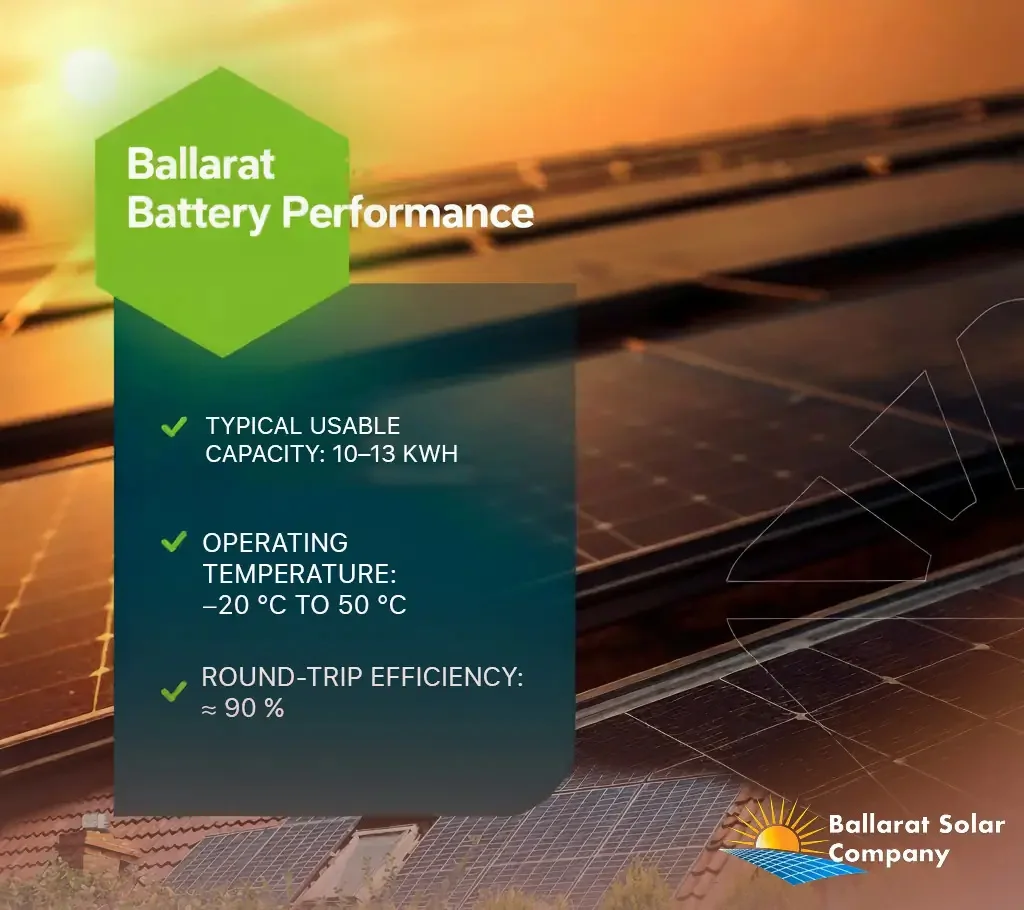
Ballarat’s winter lows around 0 °C mean cold-weather performance matters. Most modern lithium-ion systems are designed for a wide range of conditions:
- Typical usable capacity: 10–13 kWh
- Operating temperature: −20 °C to 50 °C
- Round-trip efficiency: ≈ 90 %
Choosing an appropriately rated product ensures strong performance year-round. At BSC, we only install batteries approved under the Clean Energy Council’s (CEC) product guidelines.
Local Grid Limits and Export Rules
Homes in the networks covering Ballarat and western Victoria are usually capped at around 5 kW of single-phase export to the grid. If your solar system generates more than that, excess energy is curtailed, unless you have a battery to store it. So, batteries don’t just save money; they also capture energy you’d otherwise lose.
When a Battery Makes Sense, and When It Might Not
A solar battery makes sense if you:
- Use most of your power in the evenings.
- Want protection from blackouts.
- Have very low feed-in tariffs.
- Plan to stay in your property for 5+ years.
- Are considering future electric-vehicle charging.
It may not suit you (yet) if:
- Your night-time usage is minimal.
- You have an exceptionally high daytime load.
- You expect to move soon.
BSC’s team conducts a personalised energy analysis to show your exact payback and benefits before you commit.
How to Pick the Right Capacity for Your Home
Choosing the right battery size is one of the most important decisions; it determines both your savings and your energy independence.
At Ballarat Solar Company (BSC), we size batteries based on your daily energy use and solar array output. The goal is simple: store enough solar energy to cover your typical evening and overnight needs, without overspending on capacity you rarely use.
A good rule of thumb (based on Clean Energy Regulator installation data) is:
1–1.5 kWh of battery storage for every 1 kW of solar generation capacity. So, a 6.6 kW solar system, common across Ballarat homes, generally pairs best with a 6–10 kWh battery.
A slightly larger battery can future-proof your system if you plan to add an electric vehicle, heat pump, or more appliances later.
If you’re unsure where your usage fits, BSC’s energy audit uses your actual smart-meter data to recommend the perfect capacity; no guesswork, just numbers.
How Solar Batteries Perform During Ballarat’s Winter Months
Ballarat winters are crisp and cloudy, so it’s natural to wonder how solar batteries perform when the sunlight drops. The short answer: they still perform well, just at slightly lower daily charge rates.
According to the Bureau of Meteorology (Ballarat Climate Summary), the region receives around 4.0 hours of peak sun per day in June and July, compared with over 6 hours in summer.
That means solar generation in winter is about 30–40% lower than summer levels.Here’s what that means for battery users:
- Your battery may not fill completely on overcast days, but it will still store enough to offset evening peak power.
- Colder temperatures do not harm performance; most lithium-ion batteries are rated to operate from −20 °C to 50 °C under Clean Energy Council (CEC) product standards.
- Battery efficiency (around 90%) remains stable even in winter when systems are properly installed and insulated.
To optimise for winter, you might want to run major appliances during sunny hours, check inverter settings to ensure optimal charge/discharge limits in colder weather, and keep batteries shaded but ventilated.
At BSC, we monitor and fine-tune systems remotely to ensure your storage works efficiently year-round.
- Your battery may not fill completely on overcast days, but it will still store enough to offset evening peak power.
Maintenance and Warranty: What Homeowners Should Know
Solar batteries are built for durability, but like any major appliance, they benefit from simple maintenance and awareness of warranty coverage.
Routine Maintenance
Most battery systems require very little upkeep — just an annual check by your installer. BSC recommends annual inspection, regular updates and visual checks.
Modern systems also come with remote monitoring, allowing installers to check performance data and detect issues early.
Warranty and Performance
Most batteries in Australia come with a 10-year performance warranty or a guaranteed energy throughput. This means your battery will retain a specified percentage of its capacity, usually 70–80%, by the end of the warranty period.
The Clean Energy Council (CEC) ensures all accredited battery products and installers meet strict safety and performance standards under its Accredited Installer Program.
At BSC, we are CEC-accredited installers, ensuring compliance with Australian standards and eligibility for government rebates.
The Future of Solar Batteries
The next energy revolution is already here. Government-supported Virtual Power Plant (VPP) programs allow connected homes to share stored power during peak times.
Victoria’s Solar Victoria VPP Pilot shows how thousands of small batteries can support the grid while owners earn bill credits.
Add to that future vehicle-to-home integration (EVs as batteries on wheels) and AI energy management, and Ballarat households will soon have more control than ever before.
How Small Ballarat Businesses Benefit from Solar Batteries
Small businesses, from cafés to mechanical workshops, can also benefit. A 15 kWh commercial-grade battery can cut peak demand charges, smooth out usage, and provide emergency power.
With flexible government-backed green loans and tax depreciation, many businesses now treat energy storage as an operational investment, not an expense.
BSC’s commercial team designs systems that align with your energy profile and hours of operation, ensuring the battery pays for itself faster.
So, Is a Solar Battery Worth It in Ballarat in 2026?
For most Ballarat homes and small businesses, yes!
With grid electricity at roughly 40 ¢/kWh, feed-in tariffs near zero, and a 30 % rebate reducing upfront costs, the value equation finally adds up.
Every property is different, but in 2026, a battery isn’t just about savings. It’s about energy independence, reliability, and future-proofing.
At BSC, we take the guesswork out by analysing your bills, usage patterns, and goals to design a system that delivers real returns.
So, Is a Solar Battery Worth It in Ballarat in 2026?
Ready to take control of your energy in 2026?
Talk to Ballarat Solar Company (BSC), your trusted local solar and battery experts.
- Free in-home or virtual consultation
- Government-approved products and installers
- Honest, data-driven recommendations
Call us today or visit our website to get your free quote and see how much you could save with the right solar battery setup for your Ballarat home or business.